
Friends of Grasslands
supporting native grassy ecosystems
PO Box 440
Jamison Centre
Macquarie ACT 2614
email: advocacy@fog.org.au
web: www.fog.org.au
ACEPDcustomerservices@act.gov.au
Re. Development proposed at 722 Canberra Ave Jerrabomberra, DA202544243
Friends of Grasslands (FOG) is a community group dedicated to the conservation of grassy ecosystems in south-eastern Australia - natural temperate grasslands and grassy woodlands. FOG advocates, educates and advises on matters to do with the conservation of these ecosystems, and carries out surveys and on-ground work. FOG is based in Canberra and its members include professional scientists, landowners, land managers and interested members of the public.
FOG strongly advise that DA 202544243 be rejected. The proposed light industrial development will lead to significant indirect impacts on one of the nation’s most important grassland remnants and on several grassland threatened species. Many of the forms of indirect impacts that will arise from this development have not been mentioned let alone assessed in the DA. This is despite the fact the proposed development site an integral component of what the ACT Native Grassland Strategy identifies as one of the most significant grasslands in the ACT.
If this proposed development proceeds it will be situated on part of the current Bonshaw rural lease, on land that abuts a large contiguous patch of critically endangered natural temperate grassland to the south widely known as the Bonshaw-East Jerrabomberra remnant. In Figure 1, we have added the approximate location of the proposed development to a map showing known habitat including sites that are occupied by the Canberra Grassland Earless Dragon, Tympanocryptis lineata. The site is also habitat (or potential habitat) for several other threatened species (Attachment A).
The proponent seeks approval to clear the development site prior to:
- undertaking adequate threatened species surveys
- a decision on the Eastern Broadacre strategic assessment.
The current high level of grazing on the development site is not conducive to supporting high levels of most threatened grassland fauna; however, according to expert ecological advice (Attachment A), it is likely low populations still exist across much of Bonshaw and that significant numbers still occur on neighbouring lands. Thus, under different management circumstances, it is likely some of the threatened fauna on Bonshaw may become more abundant, and a survey during a time of higher grass height would find them more widespread.
The Ecological Assessment Report submitted with the DA paperwork by the proponent acknowledges survey issues and, for Striped Legless Lizard, Delma impar, and Golden Sun Moth, Synemon plana, recommended further surveying.[1] There is no evidence follow up surveys have been completed.
Allowing this development now would prevent the enhancement of grassland on Bonshaw; however, so much more will be lost, i.e., a cost-effective option for protecting and restoring this part of the catchment and landscape of the lower Molonglo River. Connecting the Bonshaw-East Jerrabomberra and the Cookanella-Amtech remnants (Figure 1) would be a cost-effective way of establishing a highly significant grassland remnant in a landscape under significant threat. Eleven years after the Eastern Broadacre strategic assessment process commenced, it would make no sense to foreclose on this viable option now; a decision is now expected in late 2027. There is no doubt the proposed development site lies within the Eastern Broadacre ‘assessment area’ (Figure 2). Avoiding the unacceptable cumulative impacts of poor one-off decisions is a key reason why decision-makers initiate strategic assessments in the first place.
At a minimum, the proposal should not be considered until adequate impact assessment documentation has been provided. Attachment A explains the significance of the missing surveys, the forms of indirect impacts not assessed. The focus on the loss of trees is misguided; what is significant in this case is the reduction in opportunity to consolidate a large remnant of grassland. That is what should be treasured.
FOG can find no evidence this proposal has been referred for assessment under Australia’s national environmental law. FOG intends to ask that the Federal Environment Minister ‘call in’ the proposal under ss 70(1)(a) of the Environment Protection and Biodiversity Conservation Act 1999 (Cth).
The DA paperwork includes 89 documents that are poorly identified. The report of most interest to FOG, an Ecological Assessment Report, is labelled a ‘Supporting document’. FOG considers there is a high risk some members of the public will not find this document (initially, we overlooked it). Many other documents are single page documents. FOG recommends proponents be required to better consolidate DA paperwork to make it easier for the public to find summary detail, with links to technical detail as necessary. Application forms should include reference to relevant prior approval DA numbers.
Yours sincerely
Professor Jamie Pittock
President, Friends of Grasslands
1 August 2025
Reference:
[1] Path Co Pty Ltd (June 2025) Ecological Assessment Report, https://dafinder.blob.core.windows.net/dadocuments/DOCs/SUPP-202544243-ECOLOGICAL-REPORT-01.pdf, p. 20

Figure 1: Approximate location of the proposed development site (the red rectangle) in relation to habitat for Canberra Grassland Earless Dragon: Action Plan for the Canberra Grassland Earless Dragon Tympanocryptis lineata 2025-2035, p. 45
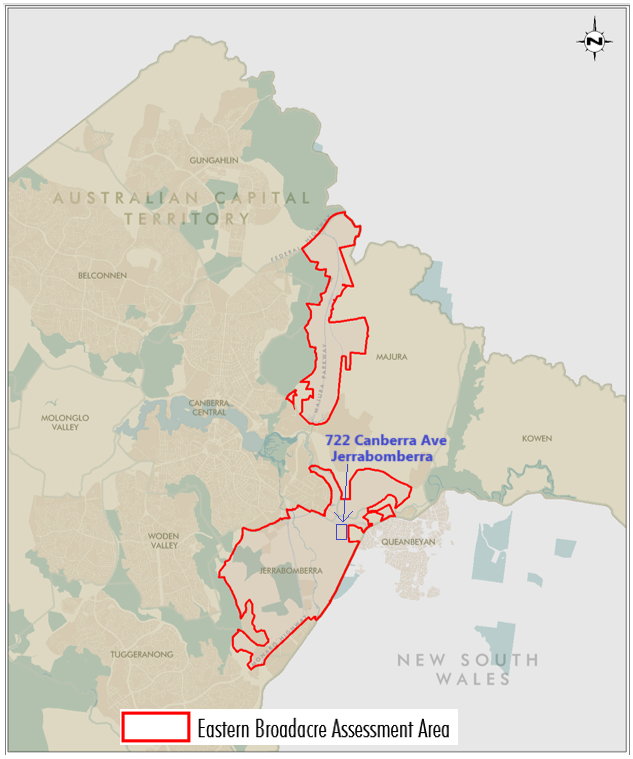
Figure 2: Approximate location of the proposed development site (purple rectangle) in relation to the Eastern Broadacre ‘Assessment Area’: Finalisation of Eastern Broadacre Strategic Assessment, Attachment B - Statement of Requirements, Appendix 1
Attachment A: Expert ecological opinion
Bonshaw Rural Lease is an integral part of a nationally significant grassland remnant
It is a major and inexplicable omission that neither the DA or accompanying ecological report, mention that the Bonshaw rural lease, including most of the proposed development area is an integral component of what the ACT Native Grassland Strategy identifies as one of the most significant grasslands in the ACT. Virtually all of the Bonshaw Rural Lease is viewed as containing habitat crucial to the survival of threatened grassland species and parts of Bonshaw are regarded as of highest conservation priority. In terms of the extent of natural temperate grassland and the abundance and diversity of threatened grassland fauna, the Cookanella-Bonshaw-East Jerrabomberra grassland remnant is amongst the largest and most important in Australia.
It should be noted that some aspects of grassland fauna habitat are not static and suitability can quickly change (either way) depending on weather conditions and management. The current high grazing level on Bonshaw is not conducive to the support of high levels of most of the threatened grassland fauna, but it is likely that low populations still exist across much of Bonshaw and that significant numbers still occur on neighbouring lands. Thus under a different management it is likely that some of the threatened fauna on Bonshaw may become more abundant and survey during times of higher grass height would find them more widespread.
When considering the impact of the DA proposal, the significance and conservation of the wider populations of the threatened grassland fauna found on Bonshaw and the immediate neighbouring lands needs to be foremost. This includes:
- The largest population and one of just a few remaining habitats of the critically endangered Canberra Earless Grassland Dragon (Tympanocryptis lineata). There are several records of this lizard within 500m to the west and south of the proposed development area, with potential habitat occurring within the development area and across neighbouring lands;
- One of the nations largest populations of the nationally vulnerable Striped Legless Lizard (Delma impar). There are records from Bonshaw itself and large numbers have been surveyed, within a kilometre of the proposed development area, in vegetation very similar to that found across Bonshaw. As noted in the ecological report accompanying the DA adequate surveys for the lizard are yet to occur. Until this happens the precautionary approach would be to assume that all of the area (bar that under tree shade) is habitat;
- In a 2011 survey, 34 Golden Sun Moths (Symemon plana) were observed within the “non-developed” lands of the DA proposal. The count is not an absolute count of the moths present, rather it provides a relative measure of the size of the population, most of which will be as caterpillars or pupa below the ground. A count of 34 indicates at a national scale a medium population compared to other locations were this moth occurs. However, the moths in the DA area are a connected and continuous part of a population where a nationally relatively large number of moths have been recorded including on the Harman Naval Base, the other parts of Bonshaw, East Jerrabomberra and Cookanella. Similarly to the Striped Legless lizard adequate surveying of the site has yet to occur and until that happens most of the DA area should be regarded as habitat;
- Contrary to statements in the ecological report – rock does outcrop within the Development Area and there is suitable habitat of the nationally vulnerable Pink-Tailed Worm Lizard present. This lizard has been recorded within 500m of the proposed development area on an outcrop to the south, and an outcrop on Cookanella (both of the same geology of the outcropping on Bonshaw). The lizard was also recorded a few 100 metres to the north, in between Canberra Avenue and the rail line, under a tile surveying for Striped Legless Lizard, in an exotic grassland, 100m from the nearest rock outcrop. This suggests that it is at least possible that this lizard moves through much of the Bonshaw area;
- There are about a dozen records of the ACT listed vulnerable Perunga Grasshopper (Perunga ochracea) from Cookanella, Bonshaw and East Jerrabomberra, including one record just outside the western edge of the DA proposal. This Grasshopper is known from only about 30 locations of which the grasslands of which Bonshaw is a component are amongst the largest of remaining habitat areas;
- The ACT Government has prepared a nomination of the Canberra Raspy Cricket (Cooraboorama canberrae) a rare species endemic to Canberra’s grasslands, to be listed as threatened under the EPBC Act. Although not yet recorded in the DA proposal area it has been recorded nearby, including on adjacent lands in Cookanella, the vegetated strip between the two lanes of Canberra Avenue to the north and there are many records from East Jerrabomberra – to which Bonshaw has a continuous grassland link; and
- There is a recent record of the nationally endangered and cryptic Key’s Matchstick Grasshopper (Keyacris scurra) from East Jerrabomberra and it is likely to be more widespread across the wider grassland of which Bonshaw is an integral component.
The proposal is likely to have significant impacts on endangered grassland and threatened grassland fauna
Given the high conservation values present within Bonshaw and neighbouring lands, you would expect that the DA would be subject to rigorous impact assessment. Instead it only considers direct vegetation clearance, has a one paragraph investigation of other potential impacts on page 39 of the ecological assessment and commits to a partial weed barrier fence, the future production of sediment erosion and weed Construction Environmental Management Plans and the undertaking of pre-tree clearance nest surveys.
The myriad of potential impacts overlooked by the DA application include
- Trenching associated with sewer and water connections that can act as pitfall traps for grassland fauna with deadly consequences. The soil disturbance also makes these areas highly susceptible to dense levels of weed invasion and a subsequent source of seed for further weed spread;
- The direct impact of the trenching itself on native grassland and threatened fauna habitat. While it is proposed to under-bore a sewer line under a patch of native grassland on Bonshaw, it is proposed that this line would then be trenched across native grassland in the wide median strip between the two lanes of Canberra Avenue and then across grassland between Canberra Avenue and the rail line. The grassland in the median strip is known habitat of the Striped Legless Lizard and Canberra Raspy Cricket, while grassland to the north of Canberra Avenue supports a dense Striped Legless Lizard population and is an area where Pink-tailed Worm Lizard and Perunga Grasshopper have been recorded;
- Weed spread from the development area into neighbouring lands. The ecological assessment report is incorrect in the claim that weed spread will mainly be a problem associated with construction. While construction is likely to lead to an abundance of weeds across the site, it is hard to envision that occupiers of an industrial estate would have the knowledge, equipment or interest to control weeds on their land. As is evident by the high cover of African Lovegrass and Chilean Needle Grass in the Canberra Avenue road reserve (where insufficient weed control occurs) if not actively managed weeds will flourish in this area and be a major source of invasive spread into neighbouring grassland and habitat. The proposal will greatly extent this front of invasion beyond Canberra Avenue and place extra weed management requirements on neighbouring lands;
- The DA proposes a fence to the south to act as a weed barrier. The DA does not explain why this barrier would not also be useful on the western Cookanella boundary. While a fence may capture some weed seed it is unlikely to prevent a significant increase in weed invasion from the proposed development area to neighbouring lands;
- A high fence is also likely to act as a perching point for avian predators, such as ravens, magpies, kestrels, kites and hawks, of threatened grassland fauna, including the critically endangered Canberra Grassland Earless Dragon. The proposed tree plantings along the planned roads on the western and southern boundaries and next to significant grassland habitat within Bonshaw are also likely to act as perching points for predators. Any buildings structures or new overhead electricity wiring is also likely to increase the effectiveness of the predation of local threatened and other fauna, including that within neighbouring lands;
- The light industrial/commercial enclave is likely to favour the flourishing of feral animal species, such as the common myna, rabbits and feral cats. These species would then hunt or feed in neighbouring lands and be a source of spread and invasion of the feral species into the neighbouring grassland and habitat.
- The landscaping plans have ignored that the proposed enclave is to be built on what is or was native grassland (which naturally has very few trees). In places the proposed tree plantings are likely to shade existing native grassland and habitat of threatened grassland species within Bonshaw or neighbouring Cookanella. Shading may make habitat unsuitable for some of the threatened fauna and some native plant species;
- The use of a dryland grass mix, rather than a mix of native grass species, as proposed in the landscape plan is just adding further exotic weed species to the area;
- There is no reasoning or support from the Bushfire agency that the proposed 11m asset protection zone around blocks will be sufficient nor that extra bushfire preparation measures would not be required on neighbouring lands. The enclave estate is also likely to result in an increased risk of fire ignition within the local area;
- While sediment ponds and associated drainage is provided for much of the proposal, there are still parts of the significant Bonshaw ecological lands that will experience direct surface water flow from developed areas, which could involve an increase in nutrients and pollutants and again favour weed establishment; and
- While areas of native grassland and known threatened fauna habitat are being retained, the application provides no details of how they will be managed or maintained in the long term, and that they simply won’t be degraded by neglect or over-grazing.
Given the significant issues raised above, at a minimum the proposal should not be assessed until adequate impact assessment documentation has been provided. Ideally such documentation should be a component of the Eastern Broadacre Strategic Assessment and include consideration of potential impacts on surrounding lands and habitat.
The application seems to be misguided in that it seems to imply that it is a scale and type of development that alone depends on whether a proposal triggers an EIS rather than also involving a consideration of the potential impacts regardless of scale or development type.
Grassland connectivity, function and enhancement
Another inadequate aspect of the DA application is its focus on trees when considering the connectivity value of proposal area and only superficial consideration of grassland connectivity and function. Around 99% of Natural Temperate Grasslands have been cleared and large (>250ha) remnants are nationally rare. Large remnants are able to support relatively large populations of grassland species, are more resilient and more capable of retaining natural ecosystem processes and functioning. Rather than wilting away at their size and increasing the boundary interface area the remaining large remnants should be treasured and where possible their area expanded and the boundary to area ratio reduced.
This DA proposal will substantially increase the boundary interface length of the northern boundary of the Cookanella-Bonshaw-East Jerrabomberra grassland remnant, and prevent a possible expansion of the northern area. Recent works within ACT offset areas demonstrate that degraded rural land that was once natural temperate grassland can be quite quickly restored to a condition that is suitable for and has resulted in the expansion of local populations of Pink-tailed Worm Lizard (Molonglo Offsets) and Striped Legless Lizard and Golden Sun Moth (Gunghalin offsets), provided as is the case for Bonshaw that these species are already present on neighbour lands.
Consolidation and the future sustainability of the large grassland remnants would be a major consideration of the Eastern Broadacre Strategic Assessment. Decisions on the future of Bonshaw and its current and potential native grassland and threatened species habitat would greatly benefit from such a wider ecosystem focused strategic consideration.
The high grassland ecological value of Bonshaw area means that it is inherently unsuitable for small lot subdivision.