

Referrals Gateway
Department of Climate Change, Energy, the Environment and Water
Re. Referral of Carrick Quarry (EPBC 2026/10581)
Friends of Grasslands (FOG) and the Conservation Council ACT Region (Council) (together, ‘we’) welcome the opportunity to comment on the referral of Carrick Quarry (EPBC 2026/10581).
Impacts on Matters of National Environmental Significance
We note the Proponent considers the proposed action is likely to have a significant impact on matters protected under the Environment Protection and Biodiversity Conservation Act 1999 (EPBC Act)[1] and that, in their view, the action is a controlled action.[2]
If it not ‘clearly unacceptable’, then we agree the action should be determined to be a controlled action. The referral notes a massive 60.19 hectares (ha) of EPBC Act listed White Box-Yellow Box-Blakely's Red Gum Grassy Woodland and Derived Native Grassland (BGW) will be cleared.[3] We note that the Conservation Advice for BGW outlines that, given its highly fragmented and degraded state, all areas should be considered critical to its survival.’[4] The proposed action will reduce the extent of BGW.
The Proponent states the proposed action will have a significant impact on Gang-gang Cockatoo, Callocephalon fimbriatum, and Diamond Firetail, Stagonopleura guttata. We note dust from the quarry may indirectly impact the respiratory system of these and other woodland bird species.
The project may have indirect impacts on protected flora species such as Hoary Sunray, Leucochrysum albicans subsp. tricolor; evidence is needed to justify the assertion these impacts will not occur. Impacts could occur due to altered surface and groundwater flows and due to dust.
Biodiversity Offset considerations
If the proposal is found to be a controlled action, we request an appropriate level of detail be published when comment is invited on draft assessment documents. To this end, our reading of assessment documents prepared to satisfy biodiversity offset requirements in NSW fail to explain how the required number of biodiversity offset credits compensate for the associated impacts.
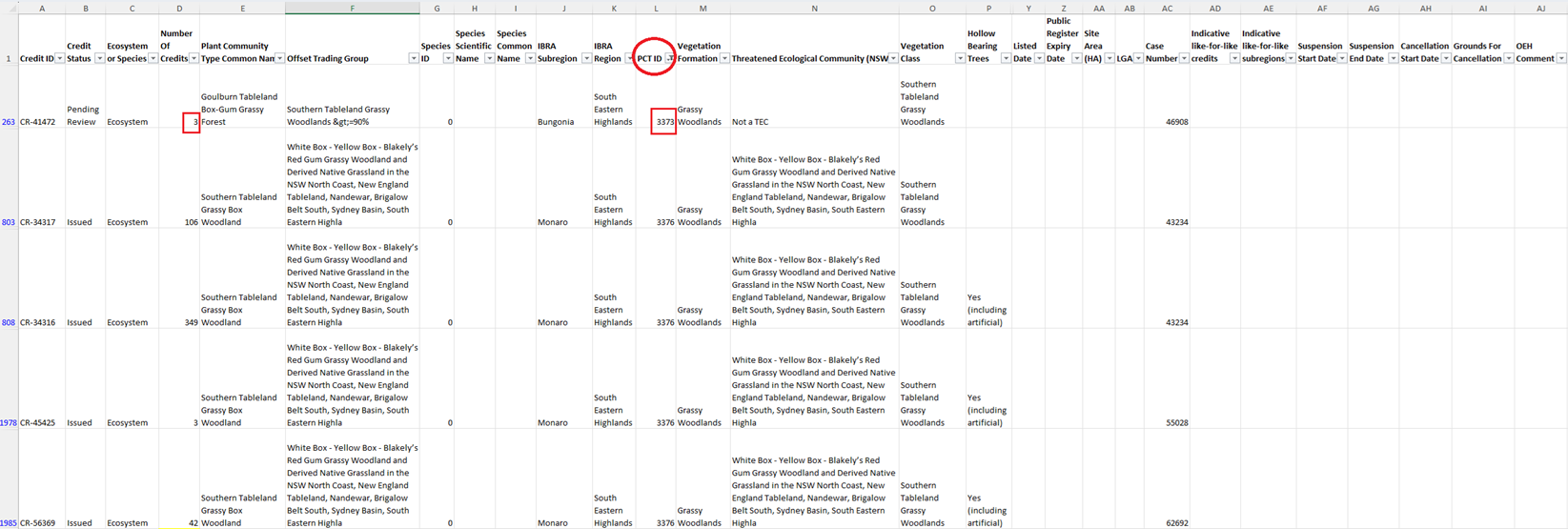
We are concerned there are not sufficient credits available. Section 4.1.4.11 of the referral states ‘A search of the BOS [NSW Biodiversity Offsets Scheme (BOS)] Credit Supply Register shows credits currently available for all communities and species predicted to be significantly impacted by the proposed Project’. We exported the NSW Credit Register on 10 August 2026. On that date, for PCTs 3373 and 3376 (understood to be forms of BGW), there were a total of five records listed (Annexure 1). For PCT 3376, there were sufficient credits available. However, for PCT 3373, a total of 1805 credits would be required. Against this requirement, on 10 August 2026, for PCT 3373, there was just one record showing a total of three (3) credits available “pending review”.
We understand, that if credits are not readily available on the market, then the proponent is likely to make payment to the Biodiversity Conservation Fund (BCF) to satisfy the offset requirement. We are concerned that, if no like-for-like credits are available, the Biodiversity Conservation Trust (BCT) will be forced by NSW law to, within three years of receiving the payment into the BCF, spend on an outcome that will not be like-for-like. This is a worrying downward spiral.
So that we and the public better understand how the BOS operates to achieve adequate and suitable offsets for protected matters, we request that the Department require the assessment documents address the information specified in Annexure 2, as well as the following:
- If the credit area start quality is less than the impact site quality: After what period will the credit area attain the quality of the impact site? What is the evidence base and/or modelling used to predict this outcome? What strategies will be implemented across the credit area to achieve this timebound outcome? How and by whom will the credit area be monitored to detect attainment of that future quality, and who enforces that outcome?
- If the credit area start quality is the same or greater than the impact site quality: Using the same assessment method as at the impact site, what will be the future quality of the site in 10 and 20 years? What is the evidence base and/or modelling used to predict this outcome? What strategies will be implemented across the credit area to achieve this timebound outcome? How and by whom will the credit area be monitored to detect attainment of that future quality, and who enforces that outcome?
We recommend information be obtained to inform an assessment of outcomes likely to be delivered should like-for-like credits not be available to be retired by either the Proponent or BCT.
Yours sincerely,
|
SIGNED |
SIGNED |
|
Prof Jamie Pittock President, Friends of Grasslands 11 August 2026 |
Dr Simon Copland Executive Director, Conservation Council ACT Region 11 August 2026 |
About us
FOG is a community group dedicated to conserving grassy ecosystems in south-eastern Australia, including natural and temperate grasslands and grassy woodlands. Our members include professional scientists, landowners, land managers, and members of the public, all committed to protecting these landscapes for the long term.
The Council is the peak non-government environment organisation for the Canberra region. Since 1981, we have spoken up for a healthy environment and a sustainable future. We campaign for a safe climate, to protect biodiversity in urban and natural areas, to protect and enhance waterways, reduce waste, and promote sustainable transport and planning for our region.
Annexure 1
Filtered result following an export of the NSW Credit Register[5] on 10 August 2026
Annexure 2
Information required to assess the adequacy of biodiversity credits
We are familiar with the EPBC Act Environmental Offsets Policy 2012 (Policy), the offset assessment guide and the How to Use Guide. These documents provide a framework for transparently evaluating the suitability and adequacy of an offset.
Under the Policy, Principle 1 is that a suitable offset must “deliver an overall conservation outcome that improves or maintains the viability of the aspect of the environment that is protected by national environment law and affected by the proposed action.”
By no later than 1 Dec 2026, compliance with a condition attached to an approval intended to deliver compensation for a residual significant impact must also deliver a net gain, i.e., for the proposed action, an outcome that improves the overall viability of BGW, Gang-Gang Cockatoo and Diamond Firetail.
In the context of the NSW BOS, the following details information requirements that, if satisfied, may provide the reader confidence the proposed credit retirements will improve the viability of BGW, Gang‑Gang Cockatoo and Diamond Firetail.
General
The proponent must:
- detail the area and quality of BGW, Gang‑Gang Cockatoo and Diamond Firetail habitat impacted. Habitat quality must be described in terms of ‘Vegetation Integrity’;
- provide evidence that credits are available from landowners selling suitable credits on the market, or provide historical market information supported by advice from the BCT that suitable credits are likely to be available to purchase and retire in the short term; and
- specify the minimum number and nature of suitable credits it will purchase directly from the market, and/or the suitable credits that will be satisfied by payment to the BCF.
Biodiversity credit information
Option 1: Proponent credit purchase.
If the proponent intends purchasing credits from the market prior to project commencement, the proponent must provide the following information:
- stewardship site(s) location, supported by maps and figures;
- the area of the stewardship site(s) that will be the ‘credit area’;
- evidence of the presence of impacted MNES on the credit area(s);
- an assessment of how the impact and credit area/s are like-for-like, i.e. that the MNES values at the credit area/s are the same as that affected by the proposed action;
- the quality of BGW, Gang‑Gang Cockatoo and Diamond Firetail habitat on the credit area(s) at commencement of offset management, characterised in terms of ‘Vegetation Integrity’. The credit area details must be supported by up-to-date surveys and baseline data;
- the net gain to be achieved for affected MNES at the credit area(s), including improvements to Vegetation Integrity that will improve the overall viability of BGW, Gang-Gang Cockatoo and Diamond Firetail; and
- an outline of the management actions and monitoring activities that will be implemented at the credit area(s) to attain, and demonstrate, the net gain for BGW, Gang-Gang Cockatoo and Diamond Firetail.
Items (b), (e) and (f) must be supported by a worked example of an Offset Assessment Guide, employing evidence-based inputs, that provides greater than 100 per cent direct offset for the credit area(s).
Option 2: BCT credit purchase.
If the proponent decides to make payments to the BCF to satisfy any credit obligations, the proponent must, as a minimum, provide the following information.
On information provided by the BCT, the proponent must:
- specify the locality(s) of potential stewardship site(s);
- assess the likely presence of impacted MNES at the locality(s) of potential stewardship site(s);
- explain how the BCF intends to incentivise establishment of biodiversity agreements, and subsequently purchase and retire like-for-like credits at those stewardship site(s);
- based on the quantum of the payments to the BCF:
- estimate the credit area/s retired to offset affected MNES;
- the minimum quality on BGW, Gang-Gang Cockatoo and Diamond Firetail habitat on the credit area(s);
- estimate the net gain to be achieved for affected MNES at the credit area(s), including improvements to Vegetation Integrity that will improve the overall viability of BGW, Gang-Gang Cockatoo and Diamond Firetail; and
- provide the template agreement and template management plan to be implemented at the stewardship site(s) that will attain, and demonstrate, the net gain for BGW, Gang-Gang Cockatoo and Diamond Firetail.
Item (d) must be supported by a worked example of an Offset Assessment Guide, employing evidence‑based inputs, that provides greater than 100 per cent direct offset for the credit area(s).
References
[1] Referral, section 4.1.4.4
[2] Referral, section 4.1.4.7
[3] Referral, section 4.1.4.5
[4] www.environment.gov.au/biodiversity/threatened/communities/pubs/43-conservation-advice.pdf, p. 20
[5] Credit supply register exported from here: www.environment.nsw.gov.au/topics/animals-and-plants/biodiversity-offsets-scheme/biodiversity-credits-market/find-credit-buyers-and-sellers/credit-supply-register# … on 10 August 2026, and filtered to show only PCTs 3373 and 3376 (personal details in columns Q-X hidden from view)